Vitamin D3 & K2: Benefits, Dosage, and Why They Work Better Together
Key Takeaways
Vitamin D3 controls how your body absorbs and uses calcium, and influences immunity, hormone production, muscle function, and mood.
Vitamin K2 tells your body where to put that calcium — into bones where it belongs, and away from arteries and soft tissues where it doesn't.
Most high-dose D3 regimens completely ignore K2, which creates unnecessary long-term risk. Pairing them is smarter and safer.
The majority of adults are under-dosed on D3, and standard multivitamins typically provide a fraction of what's needed to reach optimal levels.
Building Blocks uses high-dose D3 paired with K2 (as M
K-4) as part of a lab-monitored, performance-oriented approach to foundational nutrition.
Why Vitamin D3 and K2 Are Always Mentioned Together
If you've started looking into vitamin D — for immunity, testosterone, bone health, or just because your labs came back low — you've probably hit a point where someone told you "you need K2 with that." And then the confusion starts. What is K2? Why does it matter? Can't you just take D3 on its own?
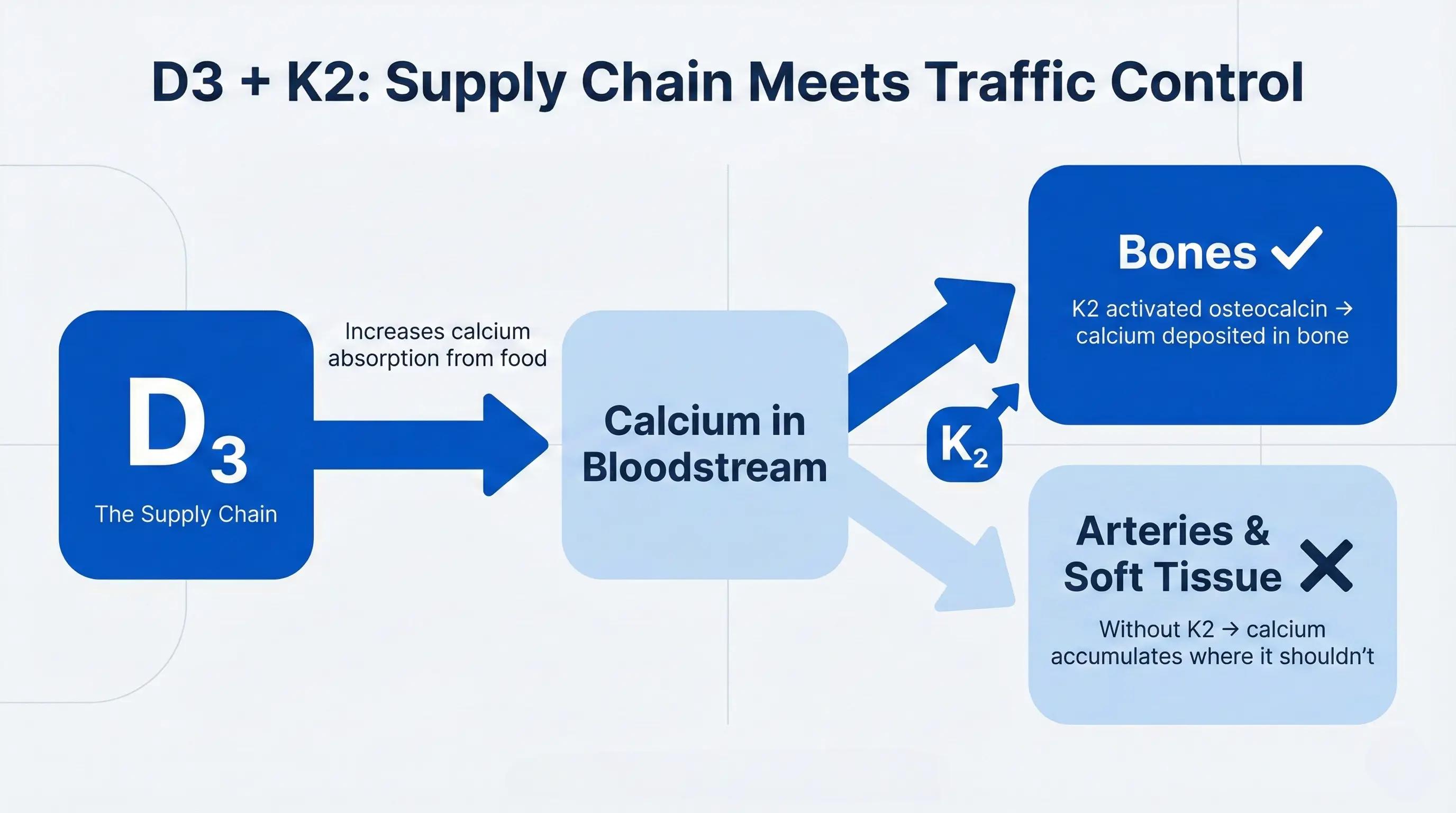
The answer comes down to calcium. D3 dramatically increases how much calcium your body absorbs from food. That's one of its core jobs, and it's a good thing — calcium is essential for bones, muscle contraction, and nerve signaling. But absorbing more calcium is only half the equation. Your body also needs to know where to put it.
That's K2's role. Vitamin K2 activates two key proteins: osteocalcin, which locks calcium into bone tissue, and matrix GLA protein (MGP), which prevents calcium from accumulating in your arteries and soft tissues. Without adequate K2, the extra calcium D3 brings in doesn't always end up in the right place.
Think of it this way: D3 is the supply chain. K2 is traffic control. Running more supply without better traffic management eventually creates problems — specifically, weaker bones than you'd expect and calcium deposits where you don't want them. That's why serious D3 supplementation and K2 go together. Not as a marketing gimmick, but as basic physiology.
What Vitamin D3 Does in Your Body
More hormone than vitamin
Vitamin D3 is technically a secosteroid hormone precursor, not a traditional vitamin. Your skin produces it from cholesterol when exposed to UVB sunlight, your liver converts it to 25-hydroxyvitamin D (the form measured in blood tests), and your kidneys activate it into its final hormone form. Nearly every tissue in your body has vitamin D receptors, which gives you a sense of how broadly it influences your biology.
The problem is that modern life — indoor work, northern latitudes, sunscreen, limited midday sun exposure — means most people don't produce anywhere near enough D3 from sunlight alone. This isn't a niche concern. Vitamin D insufficiency is one of the most common nutritional deficiencies worldwide, and it's especially prevalent in people who work indoors, have darker skin tones, carry excess body fat (D3 is fat-soluble and gets sequestered in adipose tissue), or live above the 37th parallel.
Bones, muscles, and structural integrity
D3 regulates calcium and phosphate metabolism — the two minerals most critical for bone density and skeletal strength. Without adequate D3, your body can't absorb enough calcium regardless of how much you consume. Over time, this leads to reduced bone mineral density, increased stress fracture risk, and — in severe cases — osteomalacia (softening of the bones).
Beyond bones, D3 influences muscle fiber function and neuromuscular coordination. Low D3 has been associated with muscle weakness, increased fall risk in older adults, and reduced power output — relevant for anyone training seriously or trying to maintain strength as they age.
Immunity and inflammation
D3 modulates both innate and adaptive immune function. Immune cells express vitamin D receptors, and adequate D3 status supports the production of antimicrobial peptides that serve as your body's first line of defense against pathogens. Observational studies have consistently associated low vitamin D status with higher rates of respiratory infections, though intervention trial results have been mixed. The most honest summary: D3 is unlikely to be a cure-all for immune health, but insufficiency clearly impairs immune function, and correcting it removes one biological disadvantage.
Hormones, mood, and metabolism
Vitamin D receptors are found in the testes, brain, and adipose tissue — all of which are relevant for the Maximus audience. Low vitamin D has been associated with lower testosterone levels, lower mood, and higher body fat percentage in observational research. It's important to note that these are associations, not guaranteed causal relationships. But the pattern is consistent enough that optimizing D3 is considered part of a responsible testosterone optimization strategy, and our earlier guide on vitamin D and testosterone covers this connection in detail.
For mood, the mechanism likely involves D3's role in serotonin synthesis and neuroinflammation regulation. Seasonal mood changes in northern climates correlate with periods of lowest D3 production, and supplementation trials in deficient populations have shown modest but positive effects on mood scores.
What Vitamin K2 Does (and How It Differs from K1)
Vitamin K is actually a family of compounds, and the distinction between K1 and K2 matters more than most people realize.
Vitamin K1 (phylloquinone) is abundant in leafy greens and is primarily used by the liver for blood clotting. Most people get enough K1 from diet. Vitamin K2 (menaquinone) is a different story. K2 is found in fermented foods (natto, certain cheeses, sauerkraut) and some animal products, and most Western diets provide very little of it. K2's primary job has nothing to do with clotting — it's about calcium management throughout the body.
Directing calcium to the right places
K2 activates osteocalcin, a protein produced by bone cells that binds calcium and incorporates it into the bone matrix. Without sufficient K2, osteocalcin remains inactive and calcium deposition in bone is less efficient. K2 also activates matrix GLA protein (MGP), which inhibits calcium from accumulating in arterial walls and soft tissues. This dual role — promoting bone mineralization while protecting vasculature — is why K2 is considered essential alongside high-dose D3.
MK-4 vs. MK-7: understanding the forms
K2 comes in several subtypes, but the two you'll encounter most are MK-4 and MK-7.
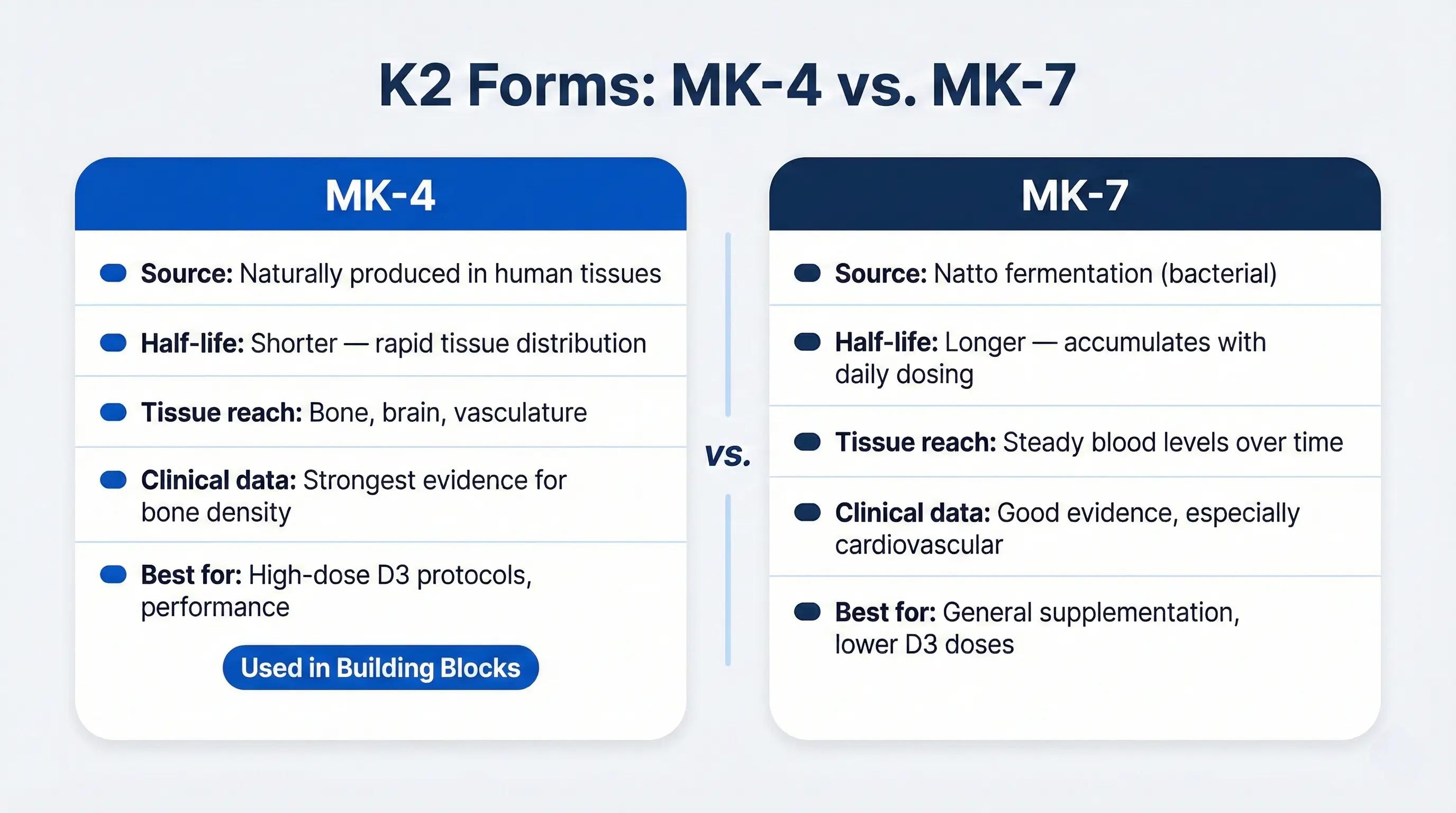
MK-7 (from natto fermentation) has a longer half-life in the bloodstream, which means it accumulates with daily dosing and maintains steady levels. It's popular in supplements for this reason. MK-4 (menatetrenone) is the form your body naturally produces from K1 and the form found in animal tissues. It has a shorter half-life but distributes rapidly into tissues including bone, brain, and vasculature. MK-4 also has the strongest clinical data for bone density outcomes and is the form used in therapeutic doses in Japan for osteoporosis management.
Building Blocks uses MK-4 for its rapid tissue uptake, strong clinical data, and alignment with the high-dose D3 protocol. When you're pushing D3 into a genuinely optimal range, you want K2 that gets to work quickly in the tissues that matter most.
How Common Is Vitamin D Deficiency (and Who's at Risk)?
More common than most people assume. Estimates suggest that roughly 40% of U.S. adults have insufficient vitamin D levels, with higher rates in certain populations.
The groups at highest risk include indoor workers with limited midday sun exposure, people living in northern latitudes (roughly above Atlanta or Los Angeles in the U.S.), individuals with darker skin tones (melanin reduces UVB-driven D3 synthesis), people carrying significant excess body fat (D3 gets trapped in adipose tissue, reducing circulating levels), older adults (skin becomes less efficient at producing D3 with age), anyone on a GLP-1 weight loss protocol where reduced food intake and rapid fat loss can both affect fat-soluble vitamin status, and people with GI conditions that impair fat absorption.
Symptoms of low D3 can include bone pain, muscle weakness, frequent illness, fatigue, and low mood — but many people with insufficient levels are completely asymptomatic. You can't feel your way to a diagnosis. Labs are what matter, and a simple 25-hydroxyvitamin D blood test gives you a clear answer. If you're investing in training, protocols, or performance optimization of any kind, knowing your vitamin D status is one of the most basic and actionable data points available.
Performance Benefits of Optimizing D3 and K2
Stronger bones and fewer training interruptions
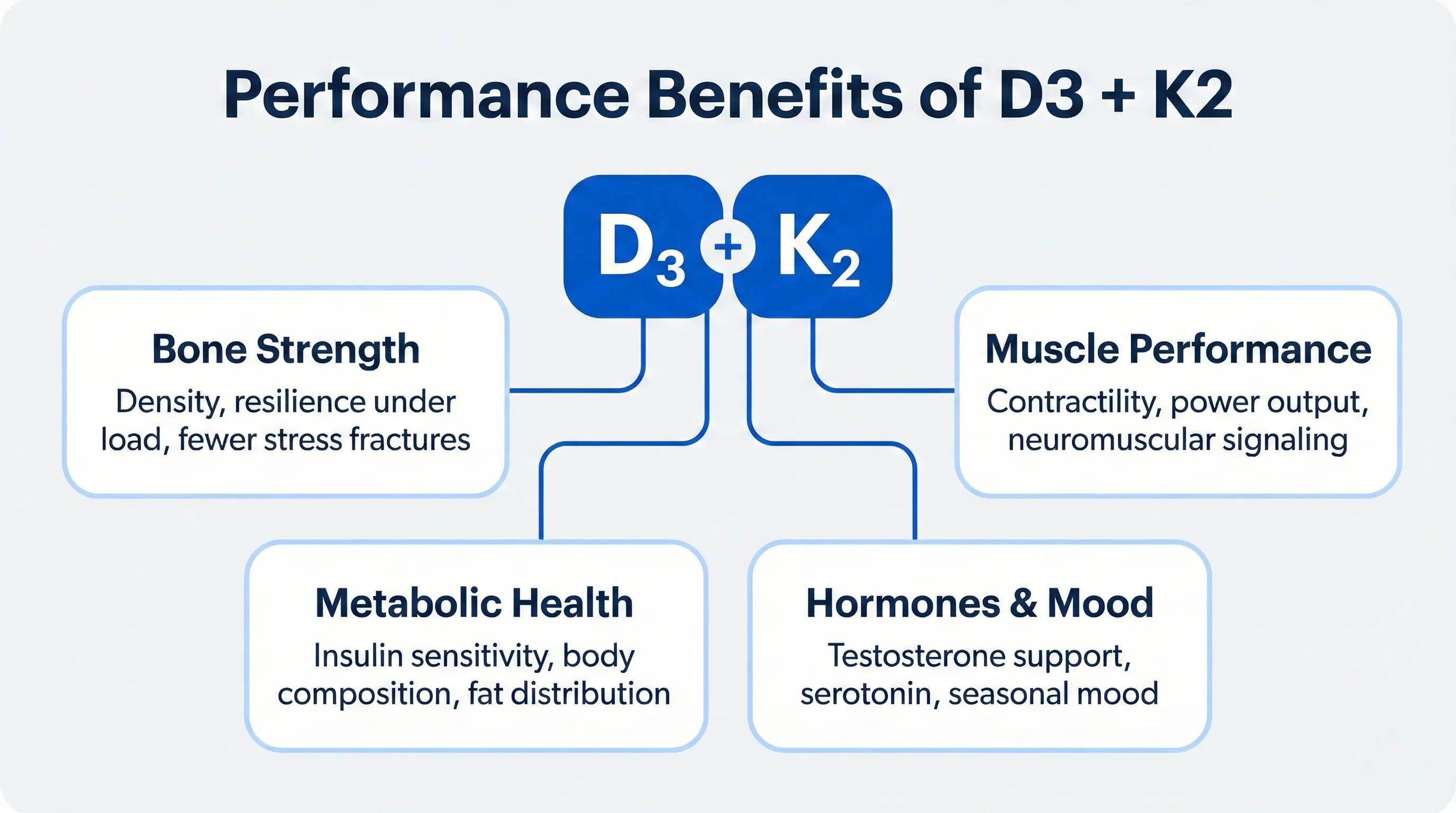
Stress fractures and overuse injuries derail training progress more than almost anything else. Adequate D3 and K2 together support the bone mineral density that makes your skeleton resilient under load — whether that's heavy squats, running, or contact sports. This isn't just relevant for older adults. Athletes and lifters at every age benefit from bones that can handle the mechanical stress they put them under.
Muscle function, power, and recovery
D3 influences muscle fiber contractility, neuromuscular signaling, and protein synthesis. Studies in D3-deficient populations have shown measurable improvements in muscle strength and power output after repletion. If you're training hard and your D3 is low, you're leaving performance on the table that's relatively easy to reclaim.
Metabolic health and body composition
Low vitamin D has been associated with impaired insulin sensitivity, higher fasting glucose, and unfavorable fat distribution. The relationship is complex and not purely causal — obesity itself lowers circulating D3, creating a feedback loop. But correcting insufficiency in the context of a metabolic health protocol is reasonable and low-risk, particularly for people on GLP-1 medications where body composition is actively changing and micronutrient demands are shifting.
Hormone optimization and mood support
For men on a testosterone protocol, D3 optimization removes one potential biological drag on T levels. It's not a testosterone booster in the supplement-marketing sense — it's a prerequisite. If your D3 is in the tank, you're asking your endocrine system to operate with a handicap. Fix the D3 first, then assess where your hormones actually stand.
The mood benefit follows the same logic. If low D3 is contributing to low mood or seasonal flatness, correcting it can noticeably improve how you feel — not because D3 is an antidepressant, but because you're restoring normal function to a system that was running on empty.
Dosing, Labs, and Safety — How to Use D3 and K2 Intelligently
How vitamin D is measured
The standard lab marker is 25-hydroxyvitamin D (25-OH D), which reflects your overall vitamin D status from both sun exposure and supplementation. Most functional and performance-oriented clinicians target levels well above the bare-minimum "sufficient" threshold that conventional lab ranges use. The goal is optimization, not just deficiency avoidance.
Why Building Blocks uses a higher dose than a typical multivitamin
Most over-the-counter multivitamins contain 400 to 1,000 IU of vitamin D3. For someone who's already sufficient and gets regular sun exposure, that might maintain levels. For someone who's insufficient — which is a large percentage of the adult population — it's not enough to meaningfully move the needle.
Building Blocks provides 10,000 IU of vitamin D3 per daily dose, paired with K2 as MK-4. This is a performance-oriented dose designed for people who are actively working with clinicians to optimize their levels, not a casual "take it and forget it" approach. It reflects the reality that meaningful D3 optimization often requires more than what generic supplements deliver.
Why K2 makes higher D3 dosing smarter
When you increase D3, you increase calcium absorption. When you increase calcium absorption without ensuring adequate K2, you risk that calcium ending up in arterial walls and soft tissue rather than bone. K2 acts as the safety mechanism — activating the proteins that direct calcium where it belongs and protecting the cardiovascular system in the process. High-dose D3 without K2 isn't necessarily dangerous in the short term, but over months and years, it's an unnecessary gamble that proper formulation eliminates.
Practical guidance
Take D3 and K2 with a meal that contains some dietary fat — both are fat-soluble and absorb significantly better with food than on an empty stomach. Consistency matters more than timing; daily dosing maintains stable levels far more effectively than sporadic megadoses.
If you have kidney disease, parathyroid conditions, granulomatous diseases, or are taking medications that affect calcium metabolism, work with your clinician before starting high-dose D3 supplementation. And regardless of your health status, if you're taking D3 at meaningful doses, periodic lab monitoring of 25-OH D and calcium is the responsible approach.
This is exactly why, when we push D3 into an optimal range for performance, we always pair it with K2 in Building Blocks and track labs over time. The dose is deliberate, the pairing is intentional, and the monitoring closes the loop.
How D3 and K2 Fit into Maximus Protocols
For people on a testosterone optimization protocol, D3 and K2 provide structural and hormonal support — stronger bones for heavy training, potential support for T levels if D3 was previously insufficient, and mood and energy benefits that compound with the hormonal improvements you're already pursuing.
For people on GLP-1 weight loss protocols, the case is particularly strong. Rapid weight loss — even healthy, medically supervised weight loss — can reduce bone mineral density if the nutritional foundation isn't in place. D3 and K2 together help protect bone density during a period when your body is under metabolic stress, while also supporting muscle function and training capacity at a time when preserving lean mass matters most.
For anyone performing at a high level — training hard, working long hours, managing stress — D3 and K2 are two of the foundational nutrients that should be in order before you worry about advanced supplementation. Along with magnesium, vitamin B12, and adequate protein, they form the micronutrient base that everything else is built on.
Stop Guessing. Start Measuring.
Don't estimate your D3 status based on how much time you spend outside. Measure it, optimize it, and make sure K2 is on board to handle the calcium your body is now absorbing more efficiently.
D3 is a hormone-like regulator of bone density, immune function, muscle performance, hormone production, and mood — and most people aren't getting nearly enough of it from sunlight or standard supplements. K2 is the traffic controller that makes high-dose D3 not just effective but safe, directing calcium into bone and away from your cardiovascular system. Building Blocks pairs them deliberately — 10,000 IU of D3 with K2 as MK-4 — because this isn't a nutrient you want to underdose and hope for the best. It's one you want dialed in, monitored, and working for you.
Vitamin D3 & K2 — FAQs
Can I take vitamin D3 without K2?
You can, and many people do. But if you're taking D3 at doses designed to meaningfully raise your levels — particularly above 2,000 IU daily — adding K2 is the more responsible approach. K2 ensures the calcium D3 helps you absorb gets directed into bone rather than accumulating in arteries and soft tissues. For short-term, low-dose supplementation, the absence of K2 isn't an immediate crisis. For long-term, high-dose protocols, pairing them is smarter.
How long does it take for vitamin D3 to raise my levels?
It depends on your starting point and dose. At meaningful daily doses, most people see measurable movement in their 25-OH D levels within four to eight weeks. Reaching a stable, optimized level typically takes two to three months of consistent daily supplementation. Periodic lab rechecks — usually every three to six months initially — help confirm you're in the right range and allow dose adjustments if needed.
Is 10,000 IU of vitamin D3 per day safe?
For many adults under clinical supervision, yes. The Endocrine Society has noted that up to 10,000 IU daily is the tolerable upper intake for adults without specific contraindications, and some individuals require doses in this range to achieve optimal 25-OH D levels. However, this is not a dose to take casually without monitoring. Lab checks for 25-OH D and calcium are important, K2 should be on board, and anyone with kidney disease, parathyroid conditions, or calcium metabolism concerns should work closely with their provider.
What's the difference between MK-4 and MK-7 for K2?
MK-4 is the form naturally produced in human tissues, distributes rapidly to bone, brain, and vasculature, and has the strongest clinical data for bone outcomes. MK-7 has a longer half-life, accumulates more steadily, and is popular in many supplements. Both are effective forms of K2. Building Blocks uses MK-4 for its rapid tissue uptake and direct clinical evidence — particularly relevant when paired with high-dose D3 in a performance context.
Should I take vitamin D3 in the morning or at night?
D3 is fat-soluble and should be taken with a meal containing dietary fat for optimal absorption. Most people find morning or midday with a meal the most convenient and consistent approach. There's some anecdotal suggestion that D3 taken late at night may interfere with melatonin production and sleep quality, though the evidence is limited. If you're taking it as part of Building Blocks, morning with breakfast is the simplest routine.